FOR RENTExpat
Rs450K/mo
Riviere Noire · West
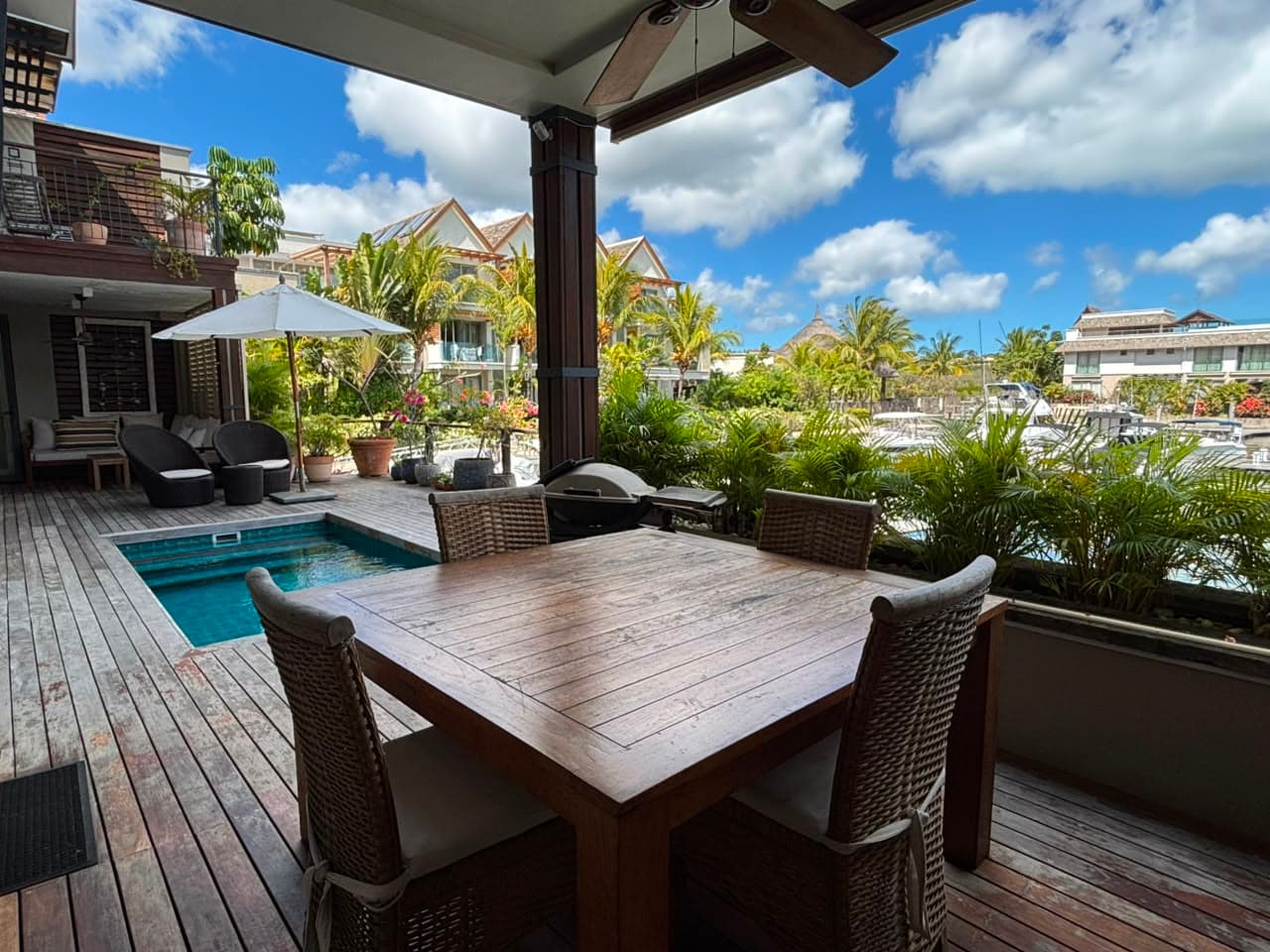
Ultimate Marina Lifestyle – Luxury Waterfront Residence, Private Mooring & Boat
44

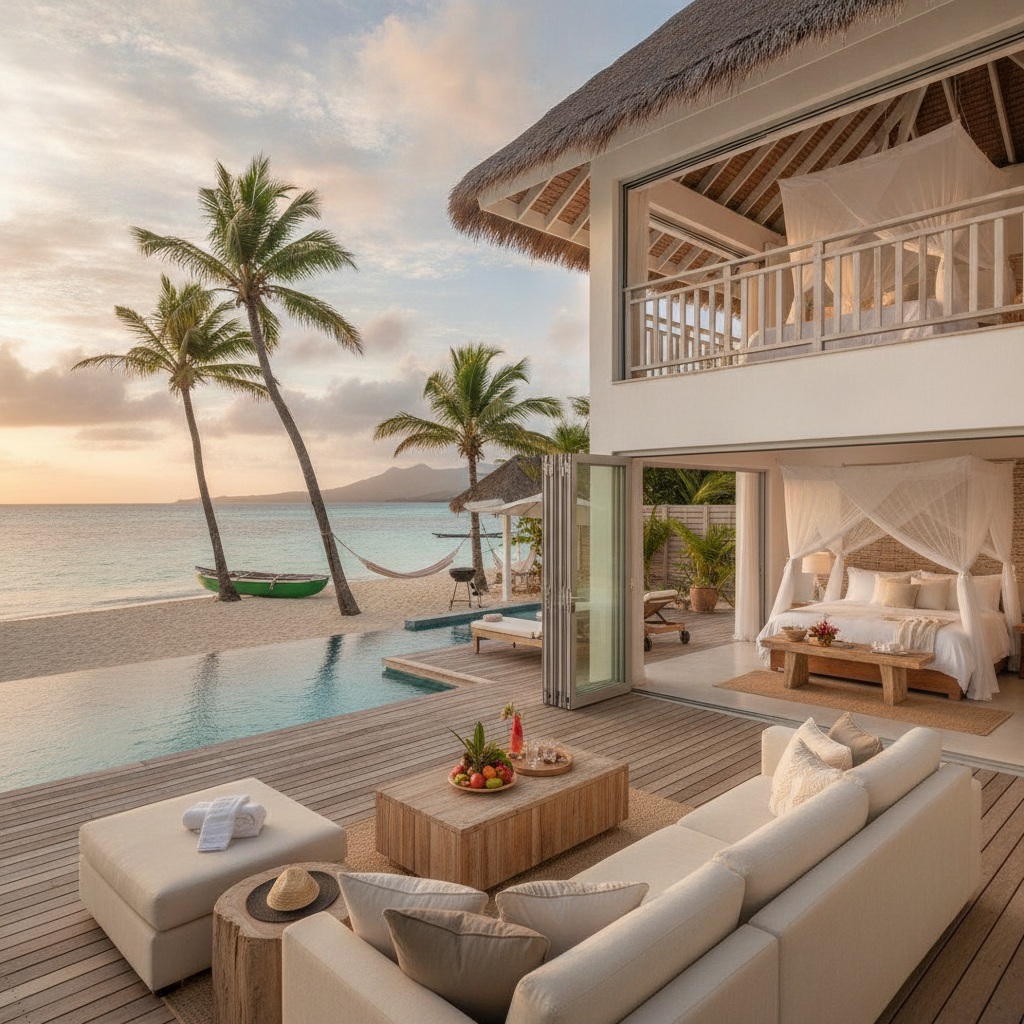
Explore beachfront houses in Mauritius. Learn where to find them, what they cost, how foreign buyers can purchase legally, and what to expect when renting.
A beachfront house in Mauritius sits directly on, or within a short walk of, the island's coastline, giving residents immediate access to the lagoon, reef, and ocean. These properties are among the most sought-after in the Indian Ocean region, and for good reason: the island's west and north coasts offer calm, sheltered water year-round, while the east coast is wilder and more private. Whether you are looking to buy or to rent, understanding the market, the legal framework, and the practical realities will save you time and money.
Mauritius is a small island, roughly 65 kilometres long and 45 kilometres wide, but its coastline varies considerably from one region to the next. Location shapes price, lifestyle, and availability.
The stretch from Grand Baie south through Pereybere, Mont Choisy, Trou aux Biches, and down to Tamarin and Black River is the most developed and internationally recognised corridor for beachfront property. Grand Baie itself is the island's main leisure hub, with restaurants, marinas, and a strong expatriate community. Properties here tend to command the highest prices, and genuine beachfront stock is limited because much of the prime land was developed decades ago.
Tamarin and Black River appeal to buyers who want a quieter lifestyle with access to surfing and dolphin-watching. The bay at Tamarin is sheltered and the community has a relaxed, village feel.
Cap Malheureux, at the island's northernmost tip, offers views across to the offshore islands of Coin de Mire and Flat Island. Beachfront houses here tend to be older Creole-style villas, though newer developments have appeared. Prices are somewhat lower than Grand Baie.
Pointe d'Esny, on the south-east coast, is a different proposition entirely. The lagoon is exceptionally clear and the pace is slow. It attracts buyers who prioritise natural beauty and seclusion over proximity to amenities.
Belle Mare and Palmar have long, wide beaches of white sand. The east coast catches the trade winds, which keeps temperatures comfortable but means the sea can be rougher than on the west. A number of large resort-integrated developments have been built here under the Property Development Scheme (PDS) and Smart City framework, making this coast particularly relevant for foreign buyers seeking residency alongside their purchase.
Foreign nationals cannot freely purchase any property in Mauritius. The law restricts freehold land purchases by non-citizens to properties sold under approved government schemes. For beachfront and coastal houses, the most relevant frameworks are:
The PDS replaced the earlier Integrated Resort Scheme (IRS) and Real Estate Scheme (RES). A PDS development is a luxury residential estate, often with shared amenities such as a clubhouse, pool, and security. Beachfront or beach-access PDS properties exist along the west and east coasts. Purchasing a property within a PDS development at a price of USD 375,000 or above makes the buyer (and their immediate family) eligible to apply for a residence permit in Mauritius. This is one of the most straightforward routes to long-term residency on the island.
Smart City developments are mixed-use urban projects combining residential, commercial, and leisure space. Some include beachfront or waterfront residential units. The same USD 375,000 threshold applies for residency eligibility.
Under the Finance Act 2026, which came into force on 13 August 2026, non-citizens buying under PDS, Smart City, RES, or G+2 schemes pay the standard 5% registration duty (borne by the buyer) and the seller pays a 5% land transfer tax. A separate 10% duty applies to the seller only on G+2 homes on State land or Pas Geometriques sold to a non-citizen. The earlier increase to 10% buyer duty introduced by the Finance Act 2025 was repealed. Always confirm current rates with the Mauritius Revenue Authority (MRA) and the Economic Development Board (EDB) before signing any agreement.
First-time buyers in Mauritius can benefit from registration duty relief on the first MUR 3 million of the purchase price for bare land, or the first MUR 6 million for a house or apartment. This relief applies to eligible buyers regardless of nationality, subject to conditions. Confirm your eligibility with a local notary.
All property transactions in Mauritius must be completed before a notary. The notary drafts the Deed of Sale, verifies title, and registers the transaction. Using an independent notary, rather than one recommended solely by the developer, is good practice.
Prices vary widely depending on location, size, condition, and whether the property is within an approved scheme. It is not practical to give precise current figures here because the market moves and exchange rates fluctuate, but the following gives a general sense of the range.
Beachfront or beach-access villas within PDS developments on the west coast typically start at USD 1 million and rise well above USD 3 million for larger, newer properties with direct sea frontage. Properties on the east coast at Belle Mare can be found at similar or slightly lower price points depending on the development.
Older, non-scheme beachfront houses are generally not available for purchase by foreign nationals unless they fall within an approved framework. Mauritian citizens and members of the Mauritian diaspora have a wider range of options under local law.
For buyers seeking residency, the minimum qualifying price of USD 375,000 under an approved scheme sets the practical floor for foreign purchasers.
Renting is a practical option for those who want to experience coastal living before committing to a purchase, or for those who do not yet meet the criteria for property ownership. The rental market for beachfront houses is active, particularly in Grand Baie, Trou aux Biches, Tamarin, and Belle Mare.
Short-term furnished rentals (one week to three months) are widely available through local agencies and international platforms. A beachfront villa with three or four bedrooms in Grand Baie or Trou aux Biches will typically cost more per week than an equivalent property set back from the water, reflecting the premium that direct beach access commands. Rates vary seasonally, with peak periods around Christmas, New Year, and European school holidays attracting the highest prices.
Long-term unfurnished or semi-furnished rentals (six months or more) are available but less commonly listed publicly. Many are arranged through word of mouth or through local estate agents. Monthly rents for a beachfront or beach-access house with three bedrooms on the west coast can range considerably, and it is worth engaging a reputable local agent who knows the specific micro-market.
For those relocating to Mauritius on an Occupation Permit, a long-term rental provides a stable base while you learn the island and identify whether you want to purchase. The Occupation Permit (Professional) requires a minimum monthly salary of MUR 50,000, harmonised across all sectors. The Occupation Permit (Investor) requires a minimum initial investment of USD 100,000. Both permits are valid for 10 years and are renewable.
For shorter stays, particularly for those exploring the island before committing to a longer rental, guest houses offer a more affordable and locally rooted alternative to hotels. Port Louis, the capital, has a number of guest houses that serve business travellers and those arriving to complete administrative processes such as permit applications. Rodrigues, the autonomous island to the north-east of Mauritius, has its own small guest house sector. Le Recif Guest House in Rodrigues is a well-known option for visitors to the island, offering simple accommodation with access to Rodrigues' quieter, less developed coastline.
Mauritius has strict rules governing construction near the coast. The Pas Geometriques is a strip of public land along the shoreline, typically 81.21 metres wide from the high-water mark, which cannot be privately owned. Any development within or adjacent to this zone requires specific permits from the relevant authorities. Buyers should verify the legal boundaries of any property and ensure that all existing structures comply with planning permissions. A thorough due diligence process, including a title search and planning verification, is essential.
Mauritius sits within the South-West Indian Ocean cyclone belt. The cyclone season runs broadly from November to April. Beachfront properties are more exposed to storm surge and wind damage than inland homes. Buyers should check that any property has been built to an appropriate standard and that comprehensive insurance, including cyclone cover, is in place. This is not a reason to avoid beachfront property, but it is a practical reality to factor into both the purchase decision and the ongoing cost of ownership.
If you plan to use the property part of the year and rent it out when you are away, professional property management is worth considering. A number of agencies in Mauritius specialise in managing villas on behalf of absent owners, handling maintenance, rental bookings, and compliance with local regulations.
Mauritius has no capital gains tax and no inheritance or estate tax, which makes it attractive for long-term property holding and intergenerational wealth planning. Rental income earned in Mauritius is subject to personal income tax on a progressive scale: 0% on the first MUR 500,000 of annual income; 10% on MUR 500,001 to MUR 1,000,000; 20% on MUR 1,000,001 to MUR 12,000,000; and 35% above MUR 12,000,000. These rates apply from the income year starting 1 July 2026. Confirm current thresholds with the MRA, as the tax framework can change with each annual Budget.
Searching for property in Mauritius has become significantly easier with the growth of online listing platforms. A reputable property portal will allow you to filter by location, property type, price range, and whether the property qualifies under an approved scheme for foreign buyers. When using any platform, look for listings that clearly state the scheme type (PDS, Smart City, or other), the land area, and whether the price is in MUR or USD, as beachfront properties within approved schemes are almost always priced in US dollars.
Engaging a local estate agent with specific knowledge of the coastal market is valuable, particularly for off-market properties and long-term rentals that are not widely advertised. Ask whether the agent is registered with the relevant professional bodies in Mauritius.
For buyers, the Economic Development Board (EDB) maintains guidance on approved schemes and the investment thresholds required for residency. Its website is the authoritative source for current rules.
Beachfront houses in Mauritius offer a distinctive combination of natural setting, legal clarity for foreign buyers within approved schemes, and a stable, low-tax environment. The west coast from Grand Baie to Tamarin, the north around Cap Malheureux, and the east coast at Belle Mare and Palmar are the main areas to focus on. Foreign buyers must purchase within an approved scheme such as PDS or Smart City, with a minimum price of USD 375,000 if residency is the goal. Registration duty for non-citizens under these schemes is 5%, following the repeal of the earlier 10% rate. The rental market is active at both the short-term and long-term end, and guest houses on both Mauritius and Rodrigues provide affordable options for those exploring the island before committing. Always work with a qualified notary, verify coastal planning permissions carefully, and confirm current tax and duty rates with the MRA and EDB.
Hand-picked
Riviere Noire · West

Tamarin · West


Baie du Cap · South

Tamarin · West

Baie du Cap · South

Beau Champ · East
Explore by region
Explore the site
Market updates, buying guidance and the best new listings, straight to your inbox.
Mauritius Real Estate · 19 Oct 2026
Understand Mauritius's ethnic groups, languages and cultural mix before you relocate. A clear, factual guide for expats and international buyers.
Mauritius Real Estate · 16 Oct 2026
Everything you need to know about house rental in Mauritius: costs, locations, lease rules, and how to find the right property. Updated guide for…
Mauritius Real Estate · 16 Oct 2026
Explore the west coast of Mauritius: top neighbourhoods, property market, beaches, lifestyle, and what foreign buyers need to know before purchasing.
Mauritius Real Estate · 15 Oct 2026
Seen our properties on PropertyCloud? How the listings match, what you get searching with us directly, and the essentials of buying in Mauritius.
Mauritius Real Estate · 13 Oct 2026
Where to find a business park in Mauritius, what leasing or buying costs, and how foreign companies set up. Covers Ebène, Grand Baie, Pailles and…
Mauritius Real Estate · 12 Oct 2026
A practical guide to business insurance in Mauritius for property owners, landlords, and investors. Covers key cover types, costs, and what to check…
Browse our current listings or speak to an agent.


